

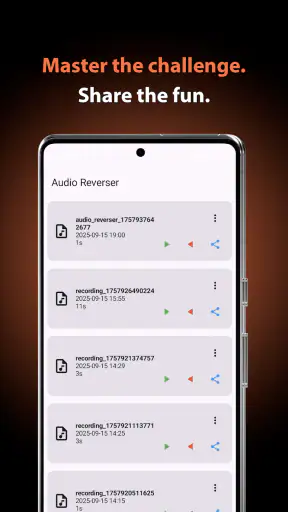
I tried Reverse Audio: Reverse Singing with a simple question in mind: is it genuinely easy to use for a quick reverse-audio challenge, or does the novelty wear off after the first attempt? My impression is that it is a focused music and audio app built around one playful idea. You record or use singing audio, reverse the result, and then try to make sense of what you hear. That makes it less like a full recording studio and more like a small party activity, a curiosity tool, or a way to turn an ordinary voice clip into a challenge.
The app is developed by AZ Screen Recorder and is available free of charge, with optional in-app purchases priced at $13.99 per item. It has an Everyone content rating, so its basic concept is suitable for a broad audience. I would still approach it with realistic expectations: this is not a replacement for a serious audio editor, vocal practice platform, or music production workstation. Its appeal comes from the reverse effect and the interaction around it, not from a long list of professional controls.
How the app feels to read and navigate
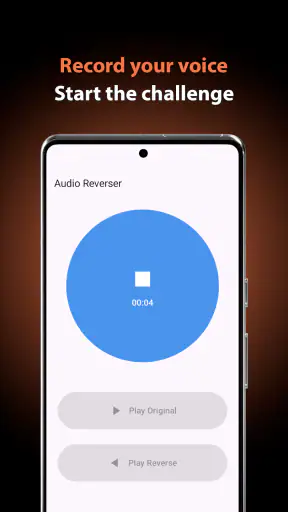
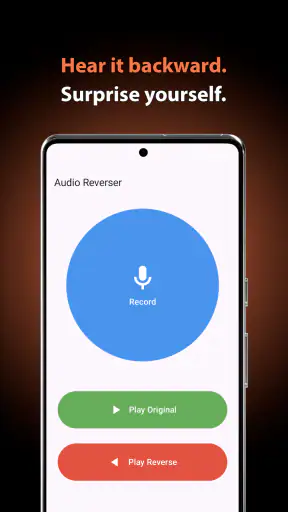
The first thing I noticed is that a reverse-singing app benefits from a very direct layout. The main task should be obvious: start a recording, create the reversed version, and listen back. That kind of short path matters more here than an elaborate interface because the fun depends on getting from idea to result quickly. If I have to search through several menus before hearing anything, the challenge loses some of its energy.
For someone who reads comfortably and prefers a small number of clear decisions, the concept is easy to understand. The store short description, “Reverse Audio,” is brief but accurate, while the longer summary frames the experience as a reverse singing challenge. Those two descriptions set a useful expectation: the app is about experimenting with reversed sound rather than managing a large personal library or producing polished tracks.
I found that the best way to use it is to treat each attempt as a small experiment. Decide what you want to sing, make a short recording, listen to the reversed result, and then try to reproduce the original from that strange playback. Keeping the process narrow makes the interface feel less intimidating, especially for somebody who does not normally use audio software.
There is also a readability advantage in a single-purpose tool. A beginner does not need to understand timelines, tracks, equalizers, compression, or file formats before trying the core activity. That simplicity can help children, casual users, and people who feel overwhelmed by conventional music apps. At the same time, anyone expecting detailed labels, editing controls, or a highly configurable workspace may find the experience too limited.
One practical tip is to decide on a repeatable routine before recording. I would use a short line, listen once without trying to decode it, then listen again while writing down what I think I heard. After that, I would attempt the line again and compare the new result. This turns a novelty effect into a small listening exercise and makes the app more rewarding than simply pressing play once.
Making the challenge easier to follow
Reverse audio can become confusing very quickly, especially when a recording contains a long phrase or several people speaking at once. I recommend beginning with one voice and a compact phrase. A short, clearly pronounced line gives the listener a better chance of noticing the sound pattern after reversal. It also reduces the frustration of trying to remember too much material.
For group use, one person can be the recorder while another person handles the guessing. That division is useful for people who find rapid switching between listening and tapping uncomfortable. It also creates a more relaxed social activity: the participant does not need to operate every part of the app while performing.
The app’s music and audio category is important here because the experience depends on listening rather than visual decoration. The result is not meant to be judged only by how a screen looks. A user who prefers audio-led interaction may appreciate that focus, while someone who needs strong visual confirmation at every stage may want to check whether the interface gives enough feedback on their device before committing to regular use.
Motor, sensory, and situational access
From a motor perspective, the most comfortable use case is a short session with deliberate taps. A reverse-singing challenge does not require the repeated precision associated with rhythm games or detailed waveform editing. That makes it potentially approachable for people who prefer simple touch interaction. I would still avoid holding the phone in one hand while singing, because accidental taps or an unstable grip can interrupt the flow of a recording.
A stand, table, or second person can make a noticeable difference. Place the phone where the microphone is not covered, begin the recording, and keep both hands free for singing or gesturing. This is a small adjustment, but it helps users with limited grip strength, tremor, or difficulty coordinating several actions at once. The app’s basic idea works better when the physical setup is calm and predictable.
For users with hearing differences, the reverse effect presents a more significant consideration. The central challenge depends on hearing the transformed recording, so the experience may be less satisfying for someone who cannot access the playback clearly. Headphones can help in a noisy room, but they are not a universal solution. A person who relies on captions, transcripts, or visual representations should not assume that a reverse-audio challenge will offer an equivalent experience.
Volume also matters. Reversed singing can sound dense and hard to separate from background noise. I would start at a comfortable level rather than turning the volume up immediately. If the result is difficult to understand, moving to a quieter room is usually more useful than simply increasing loudness. This is especially important when children are using the app or when several people are listening together.
Users who are sensitive to unpredictable or unusual sounds may want to approach the app gradually. A reversed voice can feel odd, and repeated playback may become tiring even when the recording itself is short. The easiest adjustment is to use brief clips and pause between attempts. That gives the listener control over the intensity instead of creating a continuous stream of distorted speech or singing.
There is a useful inclusive angle for people who are shy about singing. Because the result is intentionally unusual, perfection is not the point. A user who would avoid a conventional karaoke app may feel more comfortable here because mistakes become part of the challenge. I would not call that a guaranteed accessibility feature, but it is a genuine social advantage: the app can lower the pressure to sound polished.
Where it fits into everyday life
A realistic scenario would be a family waiting for food at home. One person records a short familiar phrase, another listens to the reversed version, and everyone takes turns guessing. The activity needs little preparation and can work in a few spare minutes. It is also suitable for a small gathering where people want an audio-based game without learning complicated rules.
Another use is a personal listening exercise. I can record a phrase, reverse it, and then try to sing the original while using the transformed sound as a clue. This is not the same as structured vocal training, but it encourages attention to pronunciation, rhythm, and memory. The important trade-off is that the app makes the task playful rather than precise, so it is better for curiosity than for measuring improvement.
It may also suit creators who need a quick source of amusing voice material for a private idea session. The reversed sound can inspire a joke, a challenge between friends, or a short social clip. I would keep expectations modest, though. A focused reverse-audio tool is convenient for generating the basic effect, but a conventional editor is usually better when the final result needs trimming, layering, noise cleanup, captions, or detailed export control.
Situational access changes the experience considerably. In a quiet room, the app’s central idea is easy to enjoy. On public transport, in a busy classroom, or at a crowded event, playback may be hard to hear and recording may capture unwanted background sound. A person who depends on low volume or cannot use headphones may find those environments particularly restrictive.
Privacy and social comfort also deserve a practical thought. Singing into a phone in front of other people can feel awkward, even when the activity is harmless. I would test the app in a private space first, then decide whether it suits a group. That approach helps users who are anxious about performing or who need time to understand the controls without an audience.
What works well, and where the barriers remain
The strongest part of Reverse Audio: Reverse Singing is its immediate premise. I do not need to learn music theory to understand why a reversed voice sounds strange. The app turns that simple effect into an activity with a clear objective: listen, interpret, and try again. For casual users, that is more inviting than opening a full audio editor filled with controls that are irrelevant to the challenge.
Its free entry point also makes experimentation easier. A curious user can try the basic experience before deciding whether the optional purchases are worthwhile. Since each in-app purchase is listed at $13.99, I would avoid buying anything until I had confirmed that the core activity is enjoyable and that the available options match my needs. The price makes sense only for someone who expects to return to the app, not for a person seeking a one-time novelty.
The main limitation is the narrow scope. Once I have tried several phrases, the reverse effect itself may stop feeling new. The app’s long-term value depends on how creatively I use it: with friends, as a memory exercise, or as a recurring challenge. Someone looking for a broad music toolkit should choose a standard recorder or audio editor instead. Those alternatives are usually more appropriate for trimming, arranging, mixing, and preparing finished recordings.
Another barrier is interpretation. Reversed singing is not naturally easy to understand, and the difficulty can vary dramatically with the singer’s pronunciation, tempo, and recording conditions. A user with speech differences may find the challenge unfair if the result becomes even harder to decode. That does not make the app unsuitable, but it means the group should agree that guessing is optional and that there is no need to treat the result as a test of ability.
Navigation can also become less comfortable when the user has to act quickly. If buttons are close together or feedback is subtle, people with limited dexterity or visual attention may need more time between recording and playback. My recommendation is to slow the session down instead of trying to match the pace of a group. The challenge is still enjoyable when each step is given enough time.
For visual accessibility, I would judge the experience by the clarity of the controls on the individual phone rather than assuming that a music app automatically offers every helpful adjustment. Larger system text, strong screen brightness, and a stable device position may improve comfort, but they cannot replace clear interaction design. Users who need guaranteed support for screen readers, captions, or high-contrast controls should consider whether their usual accessibility tools work smoothly with the app before relying on it.
The app is listed for devices running Android 7.0 or later, which gives it a broad compatibility range for Android users with older phones. Its current version is 1.1.2, and the app was released on September 15, 2025. Those details are useful when deciding whether an older device can run it, but performance still depends on the phone, microphone, speaker, and surrounding noise. A compatible operating system does not automatically mean an equally comfortable experience on every screen size.
Public interest is reasonably strong for a focused utility: the app has an average rating of 4.5 from around 25,000 ratings, with about 370 written reviews and over 5 million installs. I see that as encouraging evidence that the concept connects with many users, but not as proof that it will suit every ability or context. A popular novelty can still be a poor fit for someone who needs visual alternatives or professional audio controls.
My inclusive verdict
I would recommend Reverse Audio: Reverse Singing to families, friends, casual singers, and anyone who enjoys short audio challenges. Its best quality is that it makes a technically simple effect feel interactive. The app does not ask me to become an editor or musician before I can have fun. A quiet room, a short phrase, and a patient listener are enough to create a useful little activity.
I would be more cautious about recommending it as a primary tool for people who need captions, visual feedback, advanced recording controls, or a fully documented accessibility workflow. The experience is centered on hearing a reversed voice, so users with limited access to audio may encounter a fundamental barrier rather than a minor inconvenience. A conventional editor with visible waveforms and transcription support may be a better choice in that situation.
My most practical advice is to start with a short recording, use a stable phone position, keep the volume comfortable, and test the app in a quiet setting. If the controls are easy to read and the playback is accessible for you, the challenge can be a cheerful way to fill a few minutes. If you need polished music production, detailed file management, or equal participation without relying on hearing, I would skip this one and choose a more capable alternative.
Overall, I see it as a deliberately small app with a clear social purpose. It succeeds when treated as a playful reverse-singing activity, not as a complete audio solution. Its most inclusive strength is the low-pressure, short-form challenge; its biggest barrier is that the central joke and task depend on hearing the reversed result. That balance makes it worth trying for curious Android users, while also making the right audience fairly easy to identify.


